
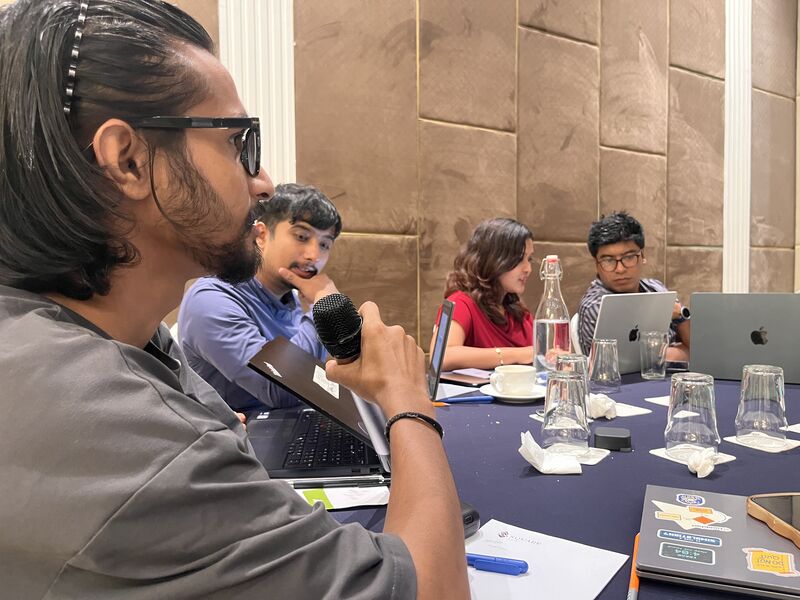
I recently had the opportunity to attend an insightful session on "From Ideas to Delivery: Building an AI-First Product Organization with Hermes Agents" by Om Prakash Sharma, organized by ACE Lalitpur (Atlassian Community Event).
Alongside the Atlassian Community Kathmandu event at The Soaltee, this was another inspiring gathering of the local Atlassian Nepal ecosystem. The session highlighted how autonomous AI agents can streamline modern product workflows by integrating deeply with Atlassian tools like Jira, Confluence, alongside Slack, Git, and MCP (Model Context Protocol) enabled platforms — helping software teams automate repetitive operational tasks while keeping human engineers in full control of critical decisions.
1. The Shift to Agentic Product Workflows
Most developer teams currently use AI merely for inline code autocomplete. Om Prakash demonstrated why the next frontier of product development is organizational:
- Multi-Tool Integration: Hermes Agents interact dynamically with ticketing systems (Jira), documentation (Confluence), chat channels (Slack), and version control (Git) to keep specifications in sync without human copy-pasting.
- Standardized Protocol (MCP): Utilizing Model Context Protocol interfaces so agents can securely query schemas, inspect databases, trigger automated builds, and run lint suites.
- Human-in-the-Loop Governance: Automating the tedious repetitive legwork while requiring explicit human approvals before any architectural migration or production release.
"The future belongs to AI-first organizations where agents perform the heavy lifting of repetitive coordination, freeing engineers to focus on architectural elegance and system reliability."
2. Key Takeaways for Backend & Full-Stack Developers
For developers architecting backend systems in PHP, Laravel, Symfony, and modern React, the session offered practical clarity:
- Rigid API Contracts: Agents require unambiguous OpenAPI specifications and predictable REST endpoints. Ambiguous schemas or inconsistent error responses immediately break agentic chains.
- Clean Database Architecture: When code generation accelerates, database integrity rules — composite indexes, foreign keys, and ACID transactions — are your primary defense against regressions.
- Automated Testing as Guardrails: High-coverage unit and integration tests serve as the deterministic boundary that lets agents experiment and refactor code safely.
A great learning experience with practical insights into the future of AI-first product engineering. Sincere thanks to speaker Om Prakash Sharma and the organizers at ACE Lalitpur for an exceptional session!
Frequently Asked Questions (FAQ)
What are Hermes Agents in software delivery?
Who presented Hermes Agents at ACE Lalitpur?
What is Model Context Protocol (MCP)?
How should backend developers prepare for AI agents?
Join the Discussion & Share Thoughts
Found this helpful? Give it a reaction below, or join the discussion on AI-first product organizations on LinkedIn.